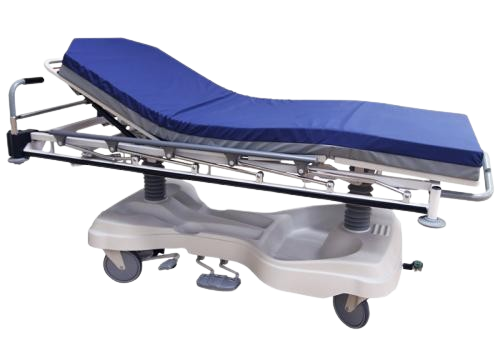
Hospital Stretcher (Non-motorized)
A non-motorized hospital stretcher is a wheeled patient transport platform used for moving patients between emergency rooms, operating theatres, imaging suites, wards, and recovery areas. It provides a stable surface for short-distance transport and for maintaining a safe semi-recumbent position during transfer and observation.
Product Description
Design and Construction
The stretcher uses a rigid metal frame with a padded mattress platform and a fluid-resistant vinyl cover for wipe-clean patient support. An articulating backrest allows manual adjustment for flat, semi-Fowler, Trendelenburg, and reverse Trendelenburg positioning. Collapsible side rails lock in the raised position for patient containment and fold down for lateral transfers. Large swivel castors with central braking support controlled movement through corridors, lifts, and treatment areas.
Clinical Applications
This patient stretcher supports emergency department triage, intra-hospital transfer, operating theatre admission, radiology movement, and inpatient transport. It is used for patients who require monitored movement between clinical departments without powered drive assistance. The articulating backrest supports preoperative positioning, post-procedure recovery, and transport of patients who need head elevation during transfer. It also supports ambulance handover and pre-hospital to hospital transfer workflows.
Load Capacity and Dimensions
The stretcher supports a safe working load of 150 to 250 kg, depending on the model configuration. The platform provides a full-length patient surface with manual backrest articulation and positional settings for flat, semi-recumbent, Trendelenburg, and reverse Trendelenburg use.
Maintenance and Durability
The mattress cover is cleaned with approved hospital disinfectants and low-lint wipes after each patient use. The frame, rails, and castors require routine inspection for locking function, wheel wear, and smooth articulation, while damaged upholstery is replaced to preserve infection control and patient comfort. With regular servicing, the stretcher provides long-term clinical use in high-turnover transport areas.
Recommended Settings
This hospital gurney is suited to tertiary hospitals, emergency departments, surgical centres, diagnostic imaging units, and inpatient wards. It also supports ambulance receiving bays, day surgery units, and facilities that move patients frequently between departments. The manual design suits sites that require dependable transport furniture without powered mechanisms.
Summary
This non-motorized stretcher provides controlled patient movement, adjustable positioning, and secure side rail protection for routine clinical transfers. It is available through MedPrax Market.
Specifications
| Parameter | Specification |
|---|---|
| Classification | Medical FurnitureHospital Furniture |
| Clinical Applications | Emergency DepartmentOperating TheatreRadiologyInpatient TransportAmbulance Pre-hospital Care |
| Detailed Specs | The non-motorized hospital stretcher is a critical patient transport device designed for the safe, comfortable, and efficient intra-hospital movement of patients between clinical areas including emergency departments, operating theatres, imaging suites, intensive care units, and inpatient wards. The stretcher platform consists of a rigid steel frame supporting a radiolucent mattress board and a high-density foam mattress with a fluid-resistant, wipe-clean vinyl cover. Articulating head and foot sections allow multi-position patient positioning—flat, Trendelenburg, reverse Trendelenburg, and semi-Fowler—to accommodate varying clinical and transport requirements. Collapsible aluminum or steel side rails lock securely in the raised position to prevent patient falls during movement, and fold flush with the mattress surface to facilitate lateral patient transfers. Four large-diameter swivel castors with central-lock braking provide smooth, directional maneuverability through hospital corridors and elevators. An integrated IV pole attachment point allows continuous infusion therapy during transport. The stretcher is designed for a safe working load of 150–250 kg, depending on the model. |
Need Procurement Support?
Not sure about technical sizing or site planning? MedPrax can help identify and supply suitable equipment — including financing assistance and customs support.
Related Medical Furniture
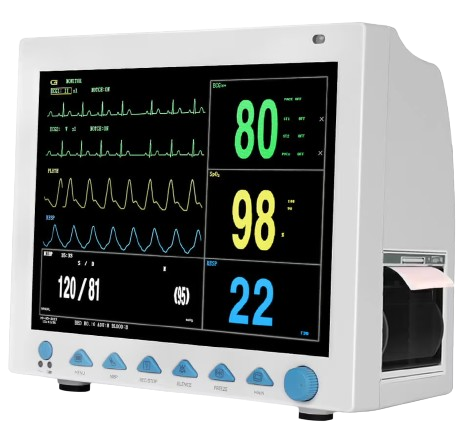
Patient Monitor
Medical device for monitoring patient vital signs in ICU, OT and ward settings