

The sterilization decision most procurement teams get wrong
Low-temperature sterilization sits at the intersection of patient safety, infection control compliance, and operational throughput. Yet most facilities that need it make the technology choice — hydrogen peroxide plasma or ethylene oxide — based on capital cost alone, without modelling the compliance overhead, instrument turnover requirements, or the five-year consumable bill.
This guide is for CSSD managers, biomedical engineers, infection control leads, and hospital procurement teams evaluating a sterilizer purchase for flexible endoscopes, heat-sensitive surgical instruments, or specialty reprocessing workflows.
What each technology actually does
Vaporised hydrogen peroxide (VH₂O₂) plasma
VH₂O₂ systems work through a defined sequence: a vacuum is drawn, hydrogen peroxide vapour is injected and diffused through the chamber, and in some designs a radiofrequency plasma field breaks down residual peroxide. Byproducts are water vapour and oxygen, so these systems vent without specialised exhaust infrastructure.
Cycle times are the primary operational advantage. Current platforms run complete sterilization cycles in approximately 28 to 75 minutes depending on load configuration. The CDC’s low-temperature sterilization technology overview documents processing times between approximately 45 and 72 minutes for gas plasma units.
Ethylene oxide (EtO)
Ethylene oxide is an alkylating gas with exceptional penetration — it diffuses through packaging, into narrow lumens, and around tightly wrapped loads. The CDC Guideline for Disinfection and Sterilization describes EtO as the established workhorse for heat- and moisture-sensitive critical items.
The clinical limitation is time. The mandatory aeration period — during which residual EtO off-gasses from the load — extends the total cycle to several hours even in modern equipment. Traditional EtO-plus-aeration workflows routinely consume 12 to 24 hours, making same-day instrument turnaround impractical.
The penetration question: where each technology has limits
EtO gas diffuses reliably into long, narrow lumens, under tight wraps, and around instruments with complex geometry. This makes it the reference technology for loads that challenge alternative methods.
VH₂O₂ systems have validated lumen restrictions. Every hydrogen peroxide platform publishes a table of compatible channel internal diameters and maximum lengths. Material compatibility is a second constraint: hydrogen peroxide is an oxidising agent, and repeated exposure degrades certain elastomers and metals. Scope manufacturers publish compatibility matrices, and warranty terms are typically linked to validated sterilization cycles.
Before evaluating any quotation, map every instrument against the candidate system’s published lumen and material compatibility table. Assumptions made at procurement stage become reprocessing failures post-installation.
Cycle time and instrument turnover: the math that decides the technology
A 45-minute VH₂O₂ cycle returns instruments to circulation within a single working session for most scope types. An EtO cycle beginning after a morning list delivers sterilized instruments the following morning at the earliest. For same-day or next-patient turnaround, the two technologies are not interchangeable.
The CDC Guideline states that EtO sterilization of flexible endoscopes is infrequent in routine practice partly because it is too time-consuming between patients. Where scope inventory accommodates overnight batch reprocessing, EtO’s material compatibility advantages can make it the right choice. Where throughput demands rapid turnaround, VH₂O₂ dominates.
Safety, ventilation, and the compliance burden
Ethylene oxide: an occupational carcinogen with regulatory consequences
EtO is classified as a known human carcinogen. Occupational exposure limits are strict:
- OSHA permissible exposure limit: 1 ppm (8-hour TWA)
- NIOSH recommended exposure limit: 0.1 ppm TWA, with a 5 ppm 10-minute ceiling
A compliant EtO installation requires: dedicated exhaust ducting and an aeration room, continuous ambient EtO monitoring with calibrated alarms, operator training records and health surveillance, regular chamber leakage testing, and state pollution control board compliance. These are facilities engineering commitments, not purchasing line items.
Vaporised hydrogen peroxide: a more contained hazard profile
VH₂O₂ systems require appropriate chemical handling discipline and general room ventilation, but no aeration room, no carcinogen monitoring programme, and no ambient gas alarm infrastructure. For facilities without dedicated facilities engineering capacity, this difference frequently determines the technology choice before capital cost is compared.
In India, any imported sterilizer is subject to CDSCO’s notified medical device framework under the Medical Devices Rules, 2017. Insist on installation qualification documentation and written site requirements from the supplier before civil works begin.
The five-year cost model buyers skip
Capital price is the smallest component of the long-term operating cost for either technology. Build the model with the following lines before comparing quotations.
Ethylene oxide cost model
| Cost line | Notes |
|---|---|
| Cartridge or cylinder cost per cycle | Batch efficiency reduces per-set cost at high volume |
| Aeration room energy and dedicated space | Fixed overhead regardless of utilisation |
| Ambient monitoring equipment and calibration | Non-negotiable compliance item |
| Ventilation capital works | Often the largest non-equipment line |
| Occupational health surveillance | Annual medical monitoring per exposed staff |
| Civil works and regulatory submissions | Site-specific; confirm before tender |
VH₂O₂ cost model
| Cost line | Notes |
|---|---|
| H₂O₂ cassette or concentrate per cycle | Higher per-set cost than EtO at small scale |
| No aeration room or exhaust works | Structural saving |
| No carcinogen monitoring programme | Structural saving |
| Shorter turnaround enables higher throughput | Revenue impact at endoscopy volume |
| Instrument and scope replacement rate | Oxidative degradation over repeated cycles |
A practical pattern: VH₂O₂ as the daily workhorse for scopes and heat-sensitive surgical sets; EtO considered only where instrument inventory or material mix genuinely requires it. Many mid-size facilities never need an in-house EtO machine.
Decision checklist before comparing prices
Work through these questions with the CSSD manager, infection control lead, and facilities engineer before requesting quotations.
- Instrument compatibility: Which instruments have manufacturer-validated cycles for VH₂O₂? Which require EtO?
- Daily case volume and scope turnaround: Does the session schedule permit overnight batch cycles?
- Building infrastructure: Does the facility support EtO exhaust duct construction and aeration space?
- Compliance capacity: Who owns occupational exposure monitoring? Who manages health surveillance records?
- Consumable pricing: Has each bidder provided cost per cycle in writing against their own pack sizes?
- Downtime contingency: What is the validated backup reprocessing pathway?
- Accreditation records: Will the reprocessing records format satisfy NABH assessors?
If more than two of these are unanswered, the facility is not ready to compare equipment prices.
Practical guidance by facility type
| Facility type | Recommended approach |
|---|---|
| High-volume endoscopy unit | VH₂O₂ as primary; EtO only where specific instruments require it |
| Multi-specialty hospital with large scope inventory | VH₂O₂ for same-day turnaround; EtO batch overnight if material mix demands it |
| District hospital without facilities engineering | VH₂O₂ only; EtO compliance requires dedicated infrastructure |
| CSSD serving multiple OTs with complex instrument sets | Evaluate both; the material compatibility matrix decides |
| Regional sterilization service | EtO batch viable at volume; full compliance infrastructure must be in place |
Acceptance and installation qualification
Neither technology should be signed off at delivery without a full installation qualification (IQ) and operational qualification (OQ) document set. These records are increasingly requested by NABH assessors.
Minimum acceptance evidence for VH₂O₂ sterilizers:
- Three consecutive cycles with biological indicators (Geobacillus stearothermophilus spore strips) showing complete kill
- Chemical indicator verification at multiple positions within a representative load
- Lumen compatibility verification against the instrument inventory
- Cycle parameter printout confirming H₂O₂ concentration and vacuum profiles
Minimum acceptance evidence for EtO sterilizers:
- Biological indicator qualification cycles per EN 1422 or equivalent
- Ambient EtO monitoring during a cycle run confirming levels below OSHA PEL
- Aeration time verification for the heaviest load type
- Chamber leakage test result
Do not accept verbal assurances in place of documented test results. These records are the evidence base for accreditation and infection control investigations.
References
- CDC Guideline for Disinfection and Sterilization: Ethylene Oxide Sterilization
- CDC Low-Temperature Sterilization Technologies Overview
- NIOSH: Ethylene Oxide IDLH Documentation (REL 0.1 ppm TWA)
- NIOSH: Ethylene Oxide Sterilizers in Health Care Facilities — Publication 89-115
- OSHA: Ethylene Oxide Standard — 29 CFR 1910.1047
- CDSCO Medical Devices Rules, 2017
See also on MedPrax Market
- Browse sterilization equipment — low-temperature and steam sterilizer listings
- Operation theatre equipment procurement guide
- Customs clearance assistance — import clearance for sterilizer consignments
- Medical equipment financing — structure sterilization capital across the department budget
Related products
Browse products related to the equipment referenced in this article.
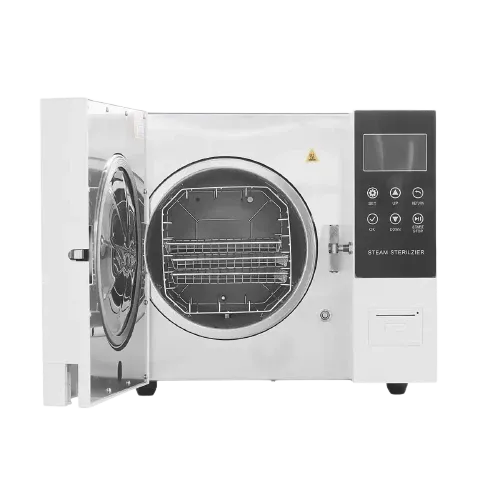
Class B Tabletop Vacuum Flash Autoclave (18L / 23L)
This tabletop vacuum steam autoclave is listed in 18 L and 23 L formats. The listing describes pre-vacuum processing, drying, a stainless-steel chamber, thermal printing and USB cycle-data logging. It supports steam sterilization of compatible instruments within a documented reprocessing workflow.
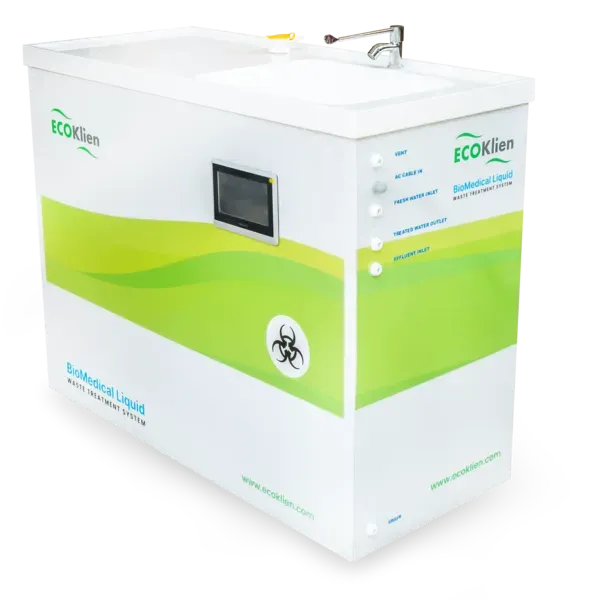
Hospital Liquid Waste Treatment System
ECOKLIEN – Biomedical Liquid Waste Treatment System uses a hybrid advanced Primary electrochemical Reactors and a Secondary electrochemical Reactors for treatment of biomedical liquid waste from hospitals, clinics and labs. System is simple and easy to operate which is Chemical free producing Multi Radicals and insitu Disinfectants thus treated effluent meeting regulatory standards.