

Introduction
Choosing a defibrillator is not the same as choosing any other piece of medical equipment. A defibrillator is the one device in the building that may sit silent for months and then be relied on, without a rehearsal, during a witnessed cardiac arrest. Buyers who treat it as a commodity purchase often end up with the wrong waveform, the wrong operating model for their staff, or a unit whose batteries and pads quietly expire between inspections.
This guide explains the defibrillator types available today — automated external defibrillators (AED), manual defibrillators, and the semi-automatic machines in between — and the technology split that still confuses many purchase committees: monophasic versus biphasic waveforms. It also covers the specification rows that separate a good quote from a bad one, readiness systems that keep a device usable, and the five-year battery and pad economics most buyers never model.
If you are sourcing for a hospital, nursing home, clinic, or ICU, this is the checklist to take into the purchase meeting. You can also browse defibrillator options and compare emergency-care equipment on MedPrax Market before sending an enquiry.
Monophasic versus biphasic: what actually changed
The waveform is the shape of the electrical shock delivered across the chest. It is the single most important technology decision in the quote.
Monophasic defibrillators
Monophasic units deliver current that flows in one direction between the two pads or paddles. This is the older technology. To achieve defibrillation, monophasic machines typically need higher energy settings — commonly 200 J, then 300 J, then 360 J in a stacked sequence. The higher energy does more than restart the heart: it also delivers a larger current through the myocardium, which increases the risk of post-shock myocardial dysfunction and skin burns at the pad sites.
Monophasic devices are rarely manufactured in new models today, but they remain in service in older facilities, ambulances, and some refurbished-equipment channels. If a supplier offers a monophasic unit as a "new" machine, treat the quote with caution — you may be looking at aged stock or a grey-market import.
Biphasic defibrillators
Biphasic units deliver current that flows in one direction and then reverses within the same shock. This waveform terminates arrhythmias at lower energy — typically 120 J to 200 J depending on the manufacturer — with equal or better first-shock success rates. Lower energy means less myocardial stress and fewer skin burns.
Modern clinical guidelines and essentially every current defibrillator standard are built around biphasic technology. When comparing quotes, the important detail is not just that a unit is "biphasic", but the specific waveform protocol the manufacturer uses (for example, impedance-compensated biphasic truncate exponential, or biphasic rectilinear). These protocols adjust the shock to the patient's measured transthoracic impedance, which matters most for large-chest or paediatric patients.
The buying implication
For any new purchase — AED, manual, or semi-automatic — specify biphasic in the enquiry. There is no clinical or economic argument left for buying a new monophasic unit. If you are maintaining an older monophasic defibrillator, keep it clearly labelled, track its energy protocol separately, and retire it from critical areas as soon as the budget allows. A biphasic defibrillator should be the default for every ward, ICU, OT, and ambulance on the site.
AED, manual, or both: matching the device to your staff
The second decision axis is who will operate the device during a cardiac arrest. This determines whether you need a fully automated external defibrillator, a manual unit, or a semi-automatic machine.
AED (automated external defibrillator)
An AED analyses the patient's rhythm and decides whether a shock is indicated. It will not allow a shock for a rhythm it does not recognise as shockable, which removes a large class of operator error. Voice prompts guide the rescuer through pad placement, analysis, and shock delivery.
AEDs are designed for first responders who are not expected to interpret rhythms: security staff, receptionists, gym trainers, flight crews, and clinical staff outside critical care areas. They are also the right choice for public-access programmes in campuses, railway stations, airports, and large office buildings.
Key AED specifications to compare:
- Operating model: fully automatic (shock delivered automatically after analysis) versus semi-automatic (rescuer presses a shock button). Most buyers prefer semi-automatic so a human confirms no one is touching the patient.
- Energy protocol: paediatric-capable AEDs use lower energy with a paediatric key or pad; confirm this if the device will ever see a child under eight.
- IP rating: a device for outdoor or dusty environments needs a higher ingress-protection rating (for example IP55 or better).
- Environmental range: operating temperature and altitude ratings matter for ambulances and field use.
- Self-testing: the unit should run automatic daily, weekly, and monthly self-tests and report readiness through an indicator or remote monitoring.
Manual defibrillator
A manual defibrillator gives the operator full control: they interpret the rhythm on the screen, select the energy, decide synchronised cardioversion versus defibrillation, and can deliver a shock without waiting for the device's algorithm. Manual units include a monitor with ECG, and higher-end units add SpO2, NIBP, EtCO2, and external pacing.
Manual defibrillators belong in the hands of trained clinicians: emergency departments, ICUs, operation theatres, catheterisation labs, and code teams. They are not the right first purchase for a small clinic whose staff are not expected to interpret arrest rhythms.
Semi-automatic defibrillator
Between the two sits the semi-automatic (or semi-automated external) defibrillator: it performs rhythm analysis like an AED but also offers manual override for a trained operator. This is a common choice for smaller hospitals and nursing homes that want one device to serve both first-responder and clinical use. Confirm the manual mode is genuinely usable — some "AED plus manual" units bury manual controls behind menus, which defeats the purpose during a code.
What we would buy, by setting
| Setting | Recommended type | Why |
|---|---|---|
| Public areas, offices, gyms, campuses | AED (semi-automatic) | First responders only need voice-prompted operation; no rhythm interpretation required |
| Small clinic / nursing home | Semi-automatic with manual override | One device covers first-responder use and trained clinical staff |
| Emergency department | Manual biphasic with monitor + pacing | Full rhythm control, synchronised cardioversion, transcutaneous pacing |
| ICU / CCU | Manual biphasic with SpO2/NIBP/EtCO2 options | Continuous monitoring and advanced airway/resuscitation support |
| Operation theatre | Manual biphasic, ideally integrated or trolley-mounted | Immediate clinician control during perioperative arrest |
| Ambulance | AED or manual depending on crew training, ruggedised | Vibration, temperature range, and battery runtime dominate the choice |
The spec rows that separate good quotes
Beyond the headline type, several specification rows separate a defensible quote from a weak one. Put these in every enquiry:
- Waveform and energy protocol: biphasic, with the manufacturer's named waveform; maximum energy (typically 200 J biphasic, sometimes up to 360 J equivalent), and paediatric dose options.
- Charge time: time to reach maximum energy on a fully charged battery and after a discharge. A slow charge time matters in a resuscitation where shocks are stacked.
- ECG monitoring: for manual units, the number of leads, screen size, waveform quality, and whether it supports 3-lead or 5-lead monitoring. Synchronised cardioversion must be explicit — many quotes mention defibrillation but hide cardioversion.
- Pacing: external transcutaneous pacing capability, including demand versus fixed modes, for unstable bradycardia. Confirm the pads are compatible with pacing.
- Additional parameters: SpO2, NIBP, EtCO2, and temperature modules, if the device will double as a transport monitor. Each extra parameter changes service and sensor costs later.
- Paddle versus pad operation: adhesive pads are standard for modern resuscitation; confirm paediatric pads, training pads, and pad size are available for the model.
- Battery type and runtime: swappable battery, monitoring runtime (typically 2 to 4 hours of continuous monitoring) and shock count per full charge. Confirm the battery does not require a factory reset to replace.
- Self-test and readiness reporting: automatic daily self-tests, a clear readiness indicator, and remote telemetry options for fleets.
- Data capture: download of event data (ECG, shocks, impedance) for code review and audits. This is now expected in hospitals that run resuscitation debriefs.
Readiness systems: the part everyone underbuilds
A defibrillator that fails a self-test is indistinguishable from no defibrillator until someone needs it. Readiness is a system, not a spec line. The components of that system:
- Daily visual check: confirm the readiness indicator is green and pads are sealed and in date. This is a one-minute task and should be assigned to a named person per shift or per day.
- Pad and battery expiry tracking: defibrillator pads have a sealed shelf life (typically two to five years depending on the model) and batteries age whether or not the unit is used. Build a register that lists serial numbers, pad expiry dates, and battery install dates for every unit on the site.
- Regular simulated use: run the device through its self-test and, where possible, a simulated rhythm using the manufacturer's test tool. This catches problems that a green LED can miss.
- Remote monitoring for fleets: AEDs used across campuses or multiple sites should report readiness centrally. Some models transmit self-test failures and pad/battery status over Wi-Fi or cellular links.
- Post-use restock protocol: after any real or training use, restock pads, battery, razor, and any accessories before returning the unit to service. Lock the unit so the protocol cannot be skipped.
Crash carts carry the defibrillator in many facilities, so readiness also belongs in the crash cart setup routine and in emergency department checklists. NABH and equivalent accreditation surveys routinely pull these records.
Battery and pad economics over five years
The purchase price of a defibrillator is often less than half its five-year cost once pads, batteries, and service are included. Model the consumables before you sign:
- Pads: a set of adult defibrillation pads typically costs a meaningful fraction of the device price. Facilities that stock one set per device plus a spare need a pad replacement budget every few years, more often if pads are used in training.
- Batteries: swappable batteries have a service life measured in years or in delivered shocks, whichever comes first. A sealed, non-swappable battery turns the whole device into a disposal problem at end of battery life.
- Service contract: decide between an AMC with scheduled preventive maintenance and a pay-per-call arrangement. For emergency devices, a preventive contract with defined response times is usually the defensible choice.
- Consumables standardisation: if you run several brands, you also run several pad and battery SKUs. Standardising on one or two models across the hospital reduces stockholding and expiry risk.
Ask suppliers for a five-year total cost of ownership statement in the quote: device price, pads (initial and replacement), battery replacement, service visits, and any software or data-download modules. The comparison should be done on this number, not the device price alone.
Compliance and documentation checks
A defibrillator is a regulated medical device, and the paperwork is part of the product. For India, confirm the device holds a valid CDSCO import or manufacturing registration and carries the correct labelling for the market. For cross-border purchases, verify that the documentation matches the destination country's requirements — the same due diligence covered in importing medical devices applies here.
Before accepting delivery, check:
- User manuals and service manual in the required language
- CE marking or the applicable local conformity mark, with the certificate from the manufacturer
- FDA 510(k) clearance letter or the equivalent for the market, if the device is US-sourced
- Declaration of conformity naming the specific model
- Pad, battery, and accessory list matched against the invoice
- Training certificate if installation and training were part of the purchase
The acceptance test that protects you
Do not sign the acceptance certificate until the device has demonstrated the functions you paid for. For a manual defibrillator the acceptance test should include:
- Power-on self-test completes and readiness indicator shows green.
- ECG simulation at a known rate displays correctly on the monitor.
- A shock is delivered into the manufacturer's test load (never into open air) at the rated energy, and the delivered-energy readout is within tolerance.
- Synchronised cardioversion is verified against a simulated rhythm.
- Pacing function delivers at the set rate and current, if the unit includes pacing.
- SpO2 and NIBP are checked against a simulator or a healthy volunteer, if the modules are fitted.
- Battery runtime is tested by disconnecting mains and confirming the monitoring runtime spec.
- Event data from the test is downloadable for the code-review record.
The same logic applies across device families — an installation qualification checklist mindset protects every capital purchase, but emergency devices deserve the strictest version because they are judged in seconds.
FAQ
Which defibrillator should a small clinic buy?
A semi-automatic defibrillator with an AED mode and manual override is usually the right balance for a small clinic: first responders can follow voice prompts, while trained doctors can take manual control during an arrest. Pair it with an oxygen kit and a basic crash cart, and confirm staff complete a CPR and AED refresher at least once a year.
What is the difference between an AED and a manual defibrillator?
An AED analyses the heart rhythm and only advises or delivers a shock when it detects a shockable rhythm. A manual defibrillator requires the operator to interpret the ECG and choose the energy, and it supports additional functions such as synchronised cardioversion, external pacing, and continuous monitoring. Choose based on who will operate the device, not on price alone.
Are monophasic defibrillators still being sold?
New monophasic defibrillators are essentially obsolete. Modern biphasic units achieve equal or better first-shock success at lower energy, with less myocardial stress and fewer skin burns. Any new purchase should specify biphasic; an existing monophasic unit should be labelled, tracked, and retired from critical areas as budget allows.
What energy levels are used for defibrillation?
Monophasic units typically use 200 J, 300 J, and 360 J stacked shocks. Biphasic units typically use lower energy, commonly 120 J to 200 J, delivered through an impedance-compensated waveform. Paediatric protocols use lower energy and often require a paediatric key or dedicated pads.
How often should defibrillator pads and batteries be replaced?
Follow the manufacturer's labelled expiry for pads — typically two to five years of sealed shelf life — and the battery service life in years or delivered shocks. Track expiry dates in a register and check them in the daily readiness check, because expired pads and weak batteries are the most common reasons a device fails when it is finally needed.
What checks are needed before accepting a defibrillator?
Run the power-on self-test, verify ECG display with a simulator, deliver a test shock into a test load at rated energy, confirm synchronised cardioversion and pacing where fitted, check battery runtime, and confirm pads, batteries, and manuals match the invoice. Only then sign the acceptance certificate.
Where this lands for different buyers
- Multi-speciality hospital: manual biphasic units with pacing and SpO2/EtCO2 options for ED, ICU, and OT; AEDs for public areas and outpatient blocks; one central readiness register.
- Nursing home or small clinic: one semi-automatic unit with manual override, a clear pad and battery register, and named daily check responsibility.
- Diagnostic centre: an AED in the reception or procedure area, with staff trained in its use.
- Ambulance or field service: ruggedised AED or manual unit with a wide temperature range, long battery runtime, and a mounting system that survives vibration.
Every one of these settings can compare defibrillator products and send a structured enquiry through MedPrax Market. For bundled emergency-care planning, the hospital setup guide covers defibrillators alongside beds, monitors, and crash carts so the whole emergency response is designed together rather than device by device.
Conclusion
A defibrillator purchase is a readiness decision. Buy biphasic, choose the operating model that matches the people who will actually run a code, verify the spec rows that determine clinical performance, and build the pad, battery, and self-test system that keeps the device alive between emergencies. The five-year cost — pads, batteries, service, and training — belongs in the comparison, and so does the acceptance test that proves the unit works before you sign.
MedPrax Market supports defibrillator sourcing for hospitals, clinics, and emergency services worldwide. Browse defibrillators, compare emergency-care equipment, or send an enquiry with your setting, staff profile, and quantity to get shortlisted options from verified suppliers.
Related products
Browse products related to the equipment referenced in this article.
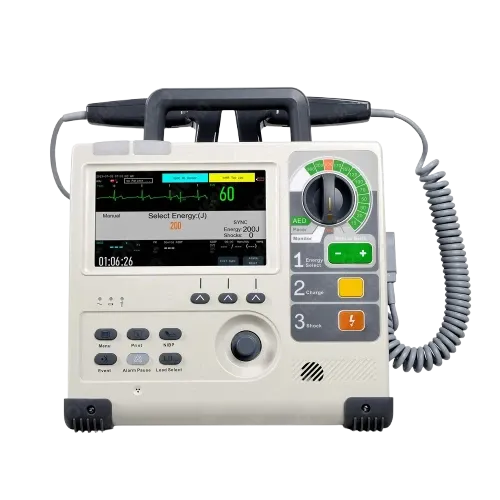
Biphasic Defibrillator Monitor with AED & External Pacing
The listed configuration is a biphasic defibrillator monitor with manual defibrillation, automated external defibrillator (AED) mode, synchronized cardioversion, transcutaneous external pacing, and 7-inch color display. It combines rhythm observation and electrical therapy functions for emergency cardiac-care workflows.
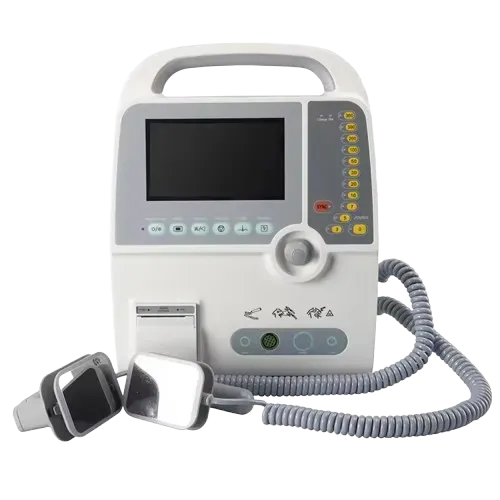
Defibrillator
A defibrillator delivers controlled electrical therapy as part of emergency cardiac care. It is used in resuscitation workflows where the required rhythm assessment and therapy functions must be available. The selected system and accessories are matched to the clinical setting and the intended defibrillation configuration.